In this article, you’ll discover simple, practical ways to bring social and emotional learning (SEL) into your classroom with SEL lessons. Learn flexible, evidence-based strategies that help students build emotional intelligence, strengthen relationships, and improve behavior and academic outcomes, in five minutes or an entire class period.
Why SEL Matters and How to Make it Easy
Social and emotional learning (SEL) has powerful short-term and long-term benefits: stronger relationships, better behavior, improved grades and attendance, higher graduation rates, and more positive mental health. As a former classroom teacher, I often found myself hunting for SEL lessons that were quick, meaningful, and genuinely fun. Some days I needed inspiration; other days I needed something I could teach in ten minutes before the bell rang. I spent hours trying to find simple, practical ways to weave SEL into my day.
What are SEL lessons?
SEL lessons are classroom activities and strategies designed to help students develop social and emotional skills, such as self-awareness, empathy, emotional regulation, decision-making, and relationship-building. These lessons give students practical tools to understand their feelings, interact positively with others, and make thoughtful choices, supporting both academic success and overall well-being.
To save you from an endless search, this article offers some of my favorite flexible, factual, and classroom-ready SEL lessons and resources you can start using today. Adapt for early childhood through high school students and easily add to your homeroom, advisory, or regular instructional time.
Greeting Circles

What Is a Greeting Circle?
A Greeting Circle is a simple, structured routine that builds connection, strengthens communication skills, and helps students practice both verbal and nonverbal social behaviors. In just a few minutes, students greet one another, make eye contact, and respond to short prompts that encourage confidence and belonging.
How to Use a Greeting Circle
Start by asking students how they’ve seen adults greet others.
- “Hi, how are you?”
- “Good morning!”
- A nod, handshake, head nod, smile, or fist bump
Then divide the class into an inner circle and an outer circle so students face a partner. Provide a 30-second prompt such as:
- What is your favorite book?
- What is your favorite game?
Students greet each partner using both verbal and nonverbal elements, answer the prompt, rotate, and repeat. In just a few rotations, students practice conversation, listening, and social awareness.
Create a simple prompt jar or classroom cards with questions for students to pull from during each circle to make it easy to repeat the activity with variety each time.
Hang-In-There Rings
Why Teach Perseverance?
Perseverance helps students develop confidence, problem-solving skills, and the emotional resilience they need to stick with challenging tasks. This short activity, adapted from William Mulcahy’s picture book Zach Hangs In There, gives students in grades K–-3 a concrete way to map out steps toward a goal.
In the story, Zach has set a goal of crossing the tricky trapeze rings on the playground, but each time he tries, he falls off before making it to the end. With friendly encouragement and positive self-talk, Zach uses a four-step approach to persevere:
- Start with a goal
- Make a plan
- Make a new plan if needed
- Keep trying to the end
How to Use the Activity
Ask students to draw a simple series of circles (like “rings”) on a sheet of paper. The final ring represents the goal. Each previous ring represents:
- a step toward their goal
- potential obstacles
- strategies to overcome them
- positive self-talk
Guide students through identifying their goal, possible challenges, and ways to persevere. Encourage phrases like I can do this or Don’t give up as they work through each “ring.” This visual map helps students slow down and reflect on how perseverance looks and feels in steps. This activity is a great example of SEL lessons for elementary students, but can easily be adapted for older learners as well.
Emotion Coping Mind Map
Older elementary students benefit from identifying emotions and exploring both helpful and unhelpful coping strategies. A mind map is a simple, visual tool that does this beautifully.
How to Build a Mind Map
- Start with an emotion in the center—anger, worry, frustration.
- Brainstorm unhelpful reactions students might see or use (yelling, hitting, shutting down).
- Brainstorm healthy coping strategies such as deep breathing, walking away, exercising, or talking to someone trusted.
Use chart paper, sticky notes, or a whiteboard to create the mind map as a class. Students can also draw individual mind maps in notebooks or on blank paper. This turns the activity into a collaborative and reusable classroom tool.
How to Take the GRRRR Out of Anger by Elizabeth Verdick and Marjorie Lisovskis includes 5 Steps to Taming That Temper, The Anger Pledge, and 6 Steps to Solving Anger Problems—great add-ons for a class discussion or bulletin board.
Empathy Discussion
Why Teach Empathy?
Empathy helps students understand others’ perspectives, navigate conflict with compassion, and build a healthier class and school culture.
This activity draws on Coach Biff Poggi’s “Golden Rule” exercise from lesson 16 of Create a Culture of Kindness in Middle School: 48 Character-Building Lessons to Foster Respect and Prevent Bullying by Naomi Drew, M.A. and Christa Tinari, M.A. Coach Poggi teaches his players that instead of asking “What can I do for me?” the central question guiding their lives should be “What can I do for you?”
How to Facilitate
- Write empathy on the board.
- Have students complete a quick 30-second pair-share on what they think it means.
- Clarify the difference between sympathy and empathy—a common misconception among adolescents. (Brené Brown’s RSA Short can help you prep, though it’s not classroom appropriate.)
- Guide the students to think about how their own classroom, community, or the world would be different if everyone lived by Coach Poggi’s “Golden Rule.”
- Brainstorm ways to reduce exclusion at school.
This activity is a practical example of SEL lessons for middle school students.
Discuss RULER Scenarios
What Is RULER?
Teaching skills to boost emotional intelligence (EQ) in students can reduce anxiety, depression, and bullying in schools. The Yale Center for Emotional Intelligence developed the RULER acronym, which helps define the aspects of EQ.
RULER outlines five key skills for building emotional intelligence
- Recognizing emotions
- Understanding causes and consequences
- Labeling emotions accurately
- Expressing emotions appropriately
- Regulating emotions effectively
Teaching RULER skills can reduce student anxiety, depression, and bullying—especially in upper grades.
How to Teach RULER Using Scenarios
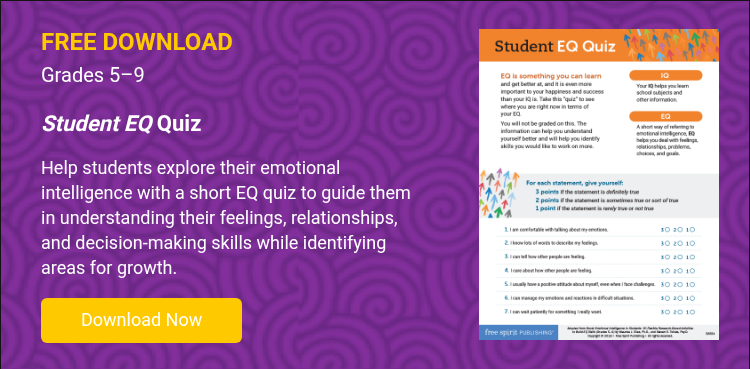
Students should begin by completing the Student EQ Quiz from Boost Emotional Intelligence in Students: 30 Flexible Research-Based Activities to Build EQ Skills (Grades 5–9) by Maurice J. Elias, Ph.D. and Steven E. Tobias, Psy.D. This short inventory will get students thinking about how they manage their emotions.
Then introduce fictional or student-created scenarios. For example: Jorge and Lucy meet in the school play and become close friends. They start dating, then later Lucy decides she no longer wants to be in the relationship. How might Jorge feel? What could he do to express his emotions appropriately? How could he regulate disappointment or embarrassment?
Using the RULER acronym, have students process Jorge’s potential emotional reaction and circumstances. Work through each letter of RULER as a class or in small groups, brainstorming healthy responses and self-talk.
SEL That Works Anytime, Anywhere
Strong SEL instruction doesn’t require complicated materials or long planning sessions. Sometimes the most effective SEL lessons are simple, hands-on activities that give students time to practice naming emotions, building empathy, regulating stress, and connecting with peers. Each of these activities can be adapted for different ages, delivered in short bursts, and reused throughout the year whenever your class needs a reset or a boost.