Educators have talked about inquiry-based teaching and learning for more than 100 years. Unfortunately, much of that talk has left teachers confused. The Inquiry Design Model addresses that confusion by focusing on three key components: questions, tasks, and sources. These components illustrate how inquiry can become a regular part of classroom life. This article focuses on the first of those components: questions.
Why Questions Matter in Inquiry-Based Social Studies
Common sense tells us that “inquire” means to ask. So, it makes sense that a key element of classroom inquiry is questions. But all questions are not equal. Both closed- and open-ended questions are useful in an inquiry classroom. The purposes of those questions, however, are very different.
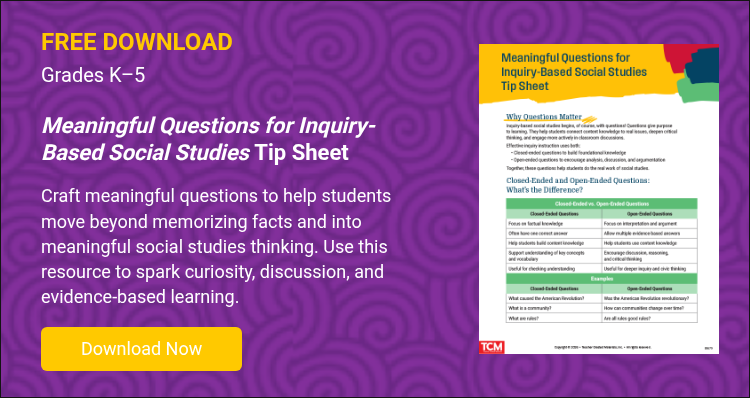
Classroom observers typically see lots of closed-ended questions.
- What is a continent?
- Who was Elizabeth Cady Stanton?
- How are state governments organized?
Such questions call for factual knowledge—ideas that most people agree with and that can be proven. This kind of knowledge helps students learn the nuts and bolts of social studies and understand notions of fact vs. opinion, causation, and historic time.
Closed-ended questions and the facts that answer them often get a bad rap as “boring.” But they only deserve that rebuke if they dominate the classroom learning environment. Facts do matter; no real understanding of the social world is possible without them. But a steady diet of facts is not enough. It frustrates most students and undercuts the power of social studies.
How Open-Ended Questions Deeply Engage Students

Inquiry teachers use closed-ended questions to build their students’ understanding of social studies content. But they do so in conjunction with open-ended questions that deeply engage students.
Open-ended questions invite students to participate in their own, evidence-based understandings of the world. Closed-ended questions help students increase their basic content knowledge. Open-ended questions offer them a chance to put that content knowledge to use.
Instead of asking students to regurgitate facts, an open-ended question asks students to take a stand on a genuine issue and then use their factual knowledge to make and support an argument about that issue. Making and supporting arguments is an important literacy skill. But it is also fundamental to civil discourse, and that purpose puts it squarely in social-studies-land.
Consider this example.
- Closed-ended question: What were the causes of the American Revolution?
- Open-ended question: Was the American Revolution revolutionary?
Students answering the closed-ended question would learn all kinds of facts. But to what purpose? The open-ended question pushes deeper. It asks students to examine the political, economic, and social consequences of the war and then construct arguments based on logic and facts—the same way historians do.
In short, open-ended questions help children learn how to become knowledgeable and active participants in civil society.
Can Elementary Students Handle Open-Ended Inquiry?
Some teachers believe that such open-ended questions and discussions will overwhelm elementary-age children. They might be suitable for secondary-level students, they say, but not for younger ones.
The research evidence is quite clear, however—even kindergarten children can navigate their way through open-ended questions such as
- How can families be the same and different?
- Are all rules good rules?
- Does where you live matter?
Questions as the Framework for Learning
It turns out that most teachers use a combination of closed-ended and open-ended questions. And they do so for a range of purposes—to push students’ thinking, to check their understanding, and to assess their knowledge and skills.
But inquiry-based teachers see an additional role for questions as the framework for their lessons. Both closed- and open-ended questions have pedagogical value, but that value increases when they are used in tandem.
Open-ended questions go by many names, including essential questions, big idea questions, and compelling questions. Regardless of the name, the function is the same: a question defines the direction of a curriculum unit rather than a topic, a list of facts, or a textbook table of contents.
This seemingly simple change—introducing a new subject with an overarching question—makes all the difference.
Think about it: Instead of accumulating a bunch of facts and reiterating them on a test, inquiry students’ job is to use the information gathered throughout the unit to answer a real question. In this scenario, the overarching, genuine, compelling question sets the purpose for a unit—a purpose that reaches far beyond remembering a parade of facts.
What Makes a Compelling Question?
In addition to setting the purpose, a compelling question has other functions. It must
- pique students’ curiosity
- suggest all the relevant people, places, and ideas in the unit
- enable students to construct a range of evidence-based arguments to answer it.
This last point is key because it highlights the importance of closed-ended questions. When students answer closed-ended questions, they learn the ideas, concepts, and facts necessary to support and extend their arguments. As such, closed-ended questions are integral to inquiry-based teaching and learning. They just need a compelling question to frame them.
An Example of Compelling and Supporting Questions
What does the relationship between closed- and open-ended questions look like? Consider this example of a compelling question.
Compelling Question
Why can’t we ever get everything we want and need?
The question is compelling because it highlights important economic concepts such as want, need, and scarcity. It enables kids to answer the question in a variety of legitimate ways. And kids love to think and talk about things they want and need.
Even the most compelling question needs reinforcement for deep learning to occur, though. So, the teachers who wrote that question also wrote three supporting questions.
Supporting Questions
- What is a want? What is a need?
- How do goods and services meet our needs and wants?
- What happens when there isn’t enough for everyone?
When young students answer the supporting questions, they are right in the middle of Economics 101. Wants and needs, scarcity and surplus, trade-offs and choices are fundamental to the economic life of a community, and to the lives we all live. Framed by a compelling question, kindergartners can do the real work of social studies.
Why Meaningful Questions Matter in Social Studies Learning
There is no perfect compelling question or set of supporting questions for a unit. The key points, however, are these
- questions drive the study of any social studies idea
- questions need to marry open-ended and closed-ended opportunities for students to gain new knowledge
- students need opportunities to construct thoughtful and well-supported arguments
When teachers frame learning around meaningful questions, social studies becomes so much more than memorizing facts. It becomes an opportunity for students to think critically, engage deeply, and participate thoughtfully in civic life.