Developing public speaking skills helps students become confident communicators, organize their ideas, and connect with others. At a time when AI-enhanced tools play an increasingly prominent role in learning, speaking and presenting give students valuable opportunities to share original thinking, demonstrate what they know, and connect authentically with others. From informal classroom conversations to formal presentations, regular speaking practice supports academic growth, English language development, and lifelong communication skills. Explore why public speaking matters, the benefits students gain, and practical ways to build these skills at every grade level.
Why Is Public Speaking Important for Students?
Public speaking has long been part of classroom learning, from presenting projects and reciting poetry to participating in historical reenactments, reading aloud, and sharing during show and tell. Yet with competing instructional priorities, opportunities for students to practice speaking and presenting may not always receive the same emphasis as reading and writing. Yet in today’s world, it is perhaps even more important for students to practice public speaking regularly. As Artificial Intelligence (AI) tools become more prevalent in education, speaking and presenting can also provide opportunities for students to demonstrate their understanding, explain their thinking, and respond to questions in real time.
Build Communication Skills for Life
Ultimately, speaking and listening are our primary means of communication. We learn to understand language before we can speak it, and to speak it before we can read and write it. When students engage in public speaking, they learn to organize their ideas and explain their thinking. Additionally, students practice adjusting their presentations to different audiences and practice active listening. Being confident in speaking before a group is a life skill both in the professional world and in our personal lives. For these reasons (and more) it is critical that we encourage students to engage in public speaking regularly.
Help Students Demonstrate What They Understand
Make Presentations a Way to Show Learning
In English class, we often turn to writing as the primary medium for students to demonstrate what they have learned. They may write short responses, create stories or poems, develop arguments, synthesize information, and eventually write full-length essays. But, by having students use public speaking as the medium for demonstrating what they have learned and understand, students develop additional key communication skills. Teachers (and students) can also ask follow-up and clarifying questions of speakers allowing them to demonstrate deeper and more nuanced understanding of their knowledge and learning.
Create an Authentic Audience for Students
Students in the audience also benefit when their classmates engage in public speaking because they learn from their peers—both about the content and how to be effective speakers. The demonstration of learning isn’t just an exchange between teacher and student, but it occurs among students as well. It becomes very clear to students who their audience is. Though we talk about the audience when teaching writing, that can seem to be an abstract concept to students, or they simply envision their audience as the teacher. But, when students utilize public speaking or presentations to demonstrate their learning, they are actually sharing that understanding with an authentic audience. These are some of the most valuable benefits of student presentations.
Build Engagement Through Student Voice and Choice
Give Students Opportunities to Share Their Knowledge
Public speaking gives students opportunities to share their knowledge, express their perspectives, and take ownership of their learning. Providing choices in presentation topics can also increase engagement by allowing students to draw on their interests and experiences. For example, my students deliver demonstration speeches in which they teach their classmates how to do something. They choose topics that are appropriate for the classroom, time limit, and audience. This allows them to share knowledge and skills their classmates may not have known they possessed, while giving their peers opportunities to learn something new.
Develop Cultural Understanding and Respectful Listening
Celebrate Different Cultures and Experiences
Allowing students to choose their topic for public speaking is the link to cultural understanding. When my students give demonstration speeches, they naturally choose topics like hula dance, how to play cricket, hair braiding, football plays, and phrases in their primary language to teach their classmates. As a result, students learn about other cultures inherently while listening to their classmates present. These topics validate each student’s experience and knowledge in ways many have never experienced before.
Teach Active Listening and Constructive Feedback
Another benefit of public speaking in the classroom is the opportunity for teachers to directly instruct and support respectful listening. I teach my students what a good listener sounds like and looks like–not just avoiding interrupting or putting one’s head down, but body language that shows we are listening. Additionally, students can be taught how to offer constructive feedback and how to ask relevant, thoughtful follow-up questions.
Many students simply aren’t aware of what good listening looks like in this setting because it hasn’t been taught. Public speaking practice opens the door to direct instruction of this kind of communication and self-awareness. The skill of active listening is important well beyond the scope of public speaking practice in the classroom. It is critical in college, in the workplace, and even (maybe especially) in our personal lives.
Support English Language Development Through Speaking Practice
We know that the English Language Arts Standards include Reading, Writing, Speaking and Listening. Oftentimes, we focus on the reading and writing portion for a variety of reasons. One being that reading and writing are typically a more significant part of our state standardized testing. Some teachers may be less comfortable teaching speaking and listening in a formal sense. But, for students, the ability, and perhaps more importantly, the confidence to speak in a language other than their primary language is critically important. Developing proficiency in a new language requires opportunities to practice, take risks, and learn from mistakes. With regular public speaking practice, English learners are afforded the opportunity to speak and concentrate on the content while learning the vocabulary and syntax of the language they need to communicate at school and beyond. This can also help them to feel like an integral part of the community of students in the classroom. When students gain confidence speaking English, they naturally can make more interpersonal connections and can build more friendships.
Teachers can support students by offering frequent low-stakes practice. For students who are in the early stages of acquiring English, providing sentence frames or visual support is very helpful. Many students benefit from practicing with a partner before delivering speeches for the entire class. Students can also present with a partner, as having another person stand alongside them may provide the support they need to feel more confident.
Practical Ways to Build Public Speaking Skills for Students
Make Speaking Practice a Regular Part of the School Day
There are many practical ways to build public speaking skills with students. The most important factor is that they need regular, consistent practice. I have heard colleagues lament that their student presentations are not engaging and, as a result, the students (and teacher) become disinterested. When I ask how often the students engage in public speaking, oftentimes, the answer is once a semester. This is part of the issue. Just as math, writing, music, and sports require practice, so does public speaking. Yes, students talk a lot, but they sometimes don’t engage in public speaking often. So, having students report to class on findings of the day at the end or beginning of class is an easy way to start.
Start With Low-Stakes Speaking Opportunities
Giving students low-stakes opportunities to speak helps build confidence and also helps the teacher identify where deficits are in their practice. Students can talk about the subject matter they are studying “in the wild.” For example, in an art class they can talk about something artistic they noticed in their world (from a literal piece of art, to package design, or an article of clothing). Students can present quick one-minute current events. Students may be given the opportunity to present in pairs or small groups. The expectation must be that every student will engage in public speaking regularly. It cannot always be the outgoing students who volunteer to present for the group.
Public Speaking Activities for Every Grade Level
Frequent, low-stakes practice can work at all grade levels. When the goal is building confidence and community, the subject matter is somewhat secondary.
Try Show and Tell in the Primary Grades
In the primary grades, having students participate in show and tell is a good place to start. When students hold something in their hands, it can also lower their anxiety. What they bring and even what they say about the object is less important than getting them talking. Show and tell works surprisingly well with older students (including high school), as well. Though I would suggest only using it once or twice with older students, it can be repeated with younger students frequently.
Build Confidence With Impromptu Speaking
Another quick activity is impromptu speaking. In this scenario, students are given three topics (usually three topics on one index card, but teachers can also have students draw three cards with one topic each). Students speak for a set amount of time on one of the topics.
For younger students, this might be 20–30 seconds, while older students may speak for a full minute. In elementary school, these topics can cover a wide variety of subjects ranging from, “Describe your favorite movie,” to “If you could have any pet, which would you choose?”
In single subject classrooms, they can also have the appearance of random topics, or can be subject-related. For example, in math class, topics could be something along the lines of “How have you used math in your ‘real’ life?” or, “How might you teach addition to a younger student?” Impromptus can be spread out with a few students delivering one at the beginning or end of the class/day, or every student could present one over the course of a segment or period of the day.
These small, practical exercises help students build confidence and learn about voice projection, posture, organization, and timing. Then, when they are tasked with longer, more formal public speaking assignments, they are set up for success. These longer presentations may be in the form of presenting group or individual projects, teaching the class a skill, solving a problem, or explaining a procedure or talking through how they approached a problem, task, or project.
Increase Presentation Complexity in Middle and High School
Middle school students benefit from presenting on topics that connect their interests to the subject matter. The balance between reliance on students’ prior knowledge and outside research can be adjusted based on the specific needs of the class. In high school classrooms, students can be expected to synthesize information from outside sources to deliver more formal structured informative and/or persuasive speeches and to be able to field follow-up questions from the teacher or classmates.
Use Simple Rubrics for Real-Time Assessment and Feedback
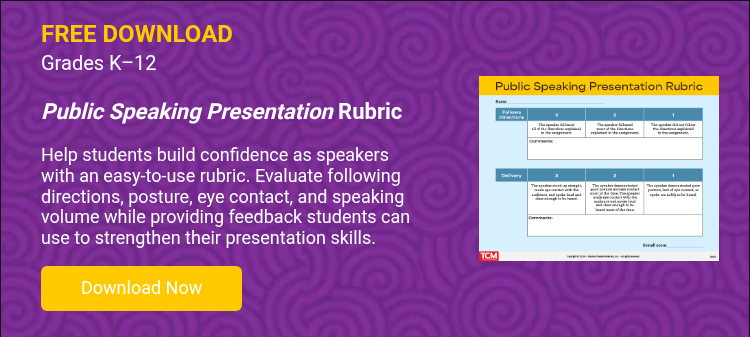
Giving students feedback using simple rubrics is important in supporting their public speaking development. With short, informal presentations, the rubric may only have two categories and these may change from task to task in order to give students more thorough feedback and encouragement over time. For example, a show-and-tell rubric may only address bringing an object and talking about it. Or when practicing timing, the rubric may address speaking within a prescribed time limit.
Depending on the activity, rubrics might address speaking volume, eye contact, clarity, organization, pacing, and audience engagement. I use short paper rubrics, but a digital one could work well, too. Of course, we want to point out areas for improvement, while highlighting strengths in our feedback. While public speaking practice does take up significant class time, the benefits are significant. An added benefit for teachers is that we assess student performance in real-time instead of collecting a stack of papers or digital submissions to be evaluated by us on our own time. This also means, students receive immediate feedback, which is also valuable.
How Can Teachers Make Public Speaking a Regular Part of Learning?
Developing public speaking skills starts with consistent opportunities for students to communicate, share ideas, and learn from one another. From show and tell and impromptu speaking to formal presentations and speeches, teachers can make speaking practice a natural part of everyday instruction. These experiences help students build confidence, strengthen communication and listening skills, and develop a deeper understanding of their classmates and the world around them. By making public speaking a regular part of classroom learning, educators help prepare students to express their ideas, connect with others, and communicate effectively in school and beyond.