<img height="1" width="1" style="display:none;" alt="" src="https://ct.pinterest.com/v3/?event=init&amp;tid=2613027410734&amp;pd[em]=<hashed_email_address>&amp;noscript=1">
Skip to content
true
Mental Health | Parenting | SEL | February 6, 2026

How to Foster Self-Advocacy for Kids

How to Foster Self-Advocacy for Kids
7:11

Learning to speak up doesn’t come naturally to every child. It’s a skill that develops through listening, trust, and practice. In this article, you’ll learn what self-advocacy for kids really looks like in everyday life, why children’s preferences and perspectives matter more than we sometimes realize, and how adults can create space for children to be heard. You’ll also explore simple, playful activities that encourage communication, confidence, and mutual respect, helping children practice expressing who they are and what they need in safe, meaningful ways.


Why Self-Advocacy for Kids Matters

Far too often we see the children in our lives as their gender and age group and make decisions accordingly. We put preschoolers in swimming class and sign six-year-olds up for soccer.

As adults, we love the kids in our lives. We know what they need, and it’s our job to keep them healthy and foster their development. But sometimes our ideas and expectations don’t fit the actual individuals we are raising. What can seem like children rebelling might in fact be a child screaming—literally and figuratively—to be heard.

This disconnect is exactly why self-advocacy for kids matters. When children are given the space and language to express their needs, preferences, and boundaries, they are better equipped to navigate relationships, learning environments, and everyday decisions with confidence.

What Is Self-Advocacy for Kids?

Self-advocacy for kids means helping children learn how to express their thoughts, needs, preferences, and feelings in respectful and effective ways. It is not about children controlling every decision; it is about teaching them that their voice has value and that communication is a skill worth practicing.

When children learn self-advocacy early, they begin to understand that their opinions matter and that listening to others matters too, an essential foundation for empathy, cooperation, and healthy relationships.

When Expectations Don’t Match the Child

My child’s grandmother has an especially challenging time managing her expectations of what my nonbinary child should like and how they should behave. One time when the two of them went out for lunch together, she assumed that she could order anything off the children’s menu and her young grandchild would enjoy it.

She could not have been more wrong.

My child refused to eat the congealed mac-and-cheese they were served, no matter how “fun” the presentation was. What looked like defiance to an adult was a clear attempt at self-advocacy for kids, a child communicating, “This doesn’t work for me.”

Why Listening Builds Confidence and Trust

FSP_Blog_HowToFosterSelf-AdvocacyForKids-650x620-2

Asking children about their preferences and encouraging them to make choices is key to establishing and teaching healthy communication. It also teaches a child to have confidence in their ideas and opinions and what it means to respect someone else.

The more children are empowered to share, the easier it will be for them to make good decisions and know how to interact with peers in respectful ways. These moments become real-life self-advocacy examples for kids, showing them that speaking up can lead to understanding rather than conflict.

Giving children the space to speak up is also fundamental to establishing trust between child and adult. When children have an adult in their life who really takes the time to listen, hear them, and respond to what they are saying, they know the door is wide open for them to communicate something serious that is affecting them or someone they know.

How Activities Support Self-Advocacy for Kids

Structured, low-pressure activities give children practice expressing themselves without fear of being “wrong.” These self-advocacy activities for kids create safe opportunities to explore preferences, boundaries, and identity while also strengthening language and social skills.

Below are two classroom- and home-friendly activities that naturally encourage communication and self-expression.

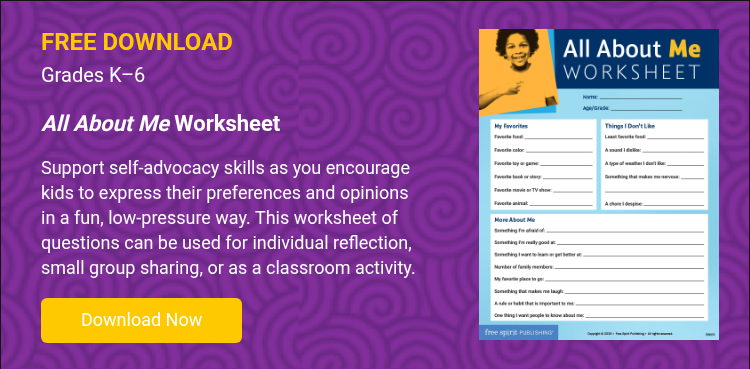
Self-Advocacy Activities for Kids: All About Me Worksheet

This activity helps children reflect on their preferences and practice sharing them with others.

  1. Print a worksheet with a list of topics such as favorite food, least favorite food, favorite color, a sound you dislike, favorite toy, favorite movie, biggest fear, and so on. Be sure to leave space after each topic.

  2. Give each child a copy of the worksheet and ask them to fill it out. If your age group isn’t reading and writing yet, you can read each line out loud, and they can draw their answers.

  3. The worksheets can be posted in the group space to share everyone’s ideas. Or you can use the responses for the following activity.

This simple exercise offers powerful self-advocacy examples for kids by validating that everyone’s answers may be different—and that those differences deserve respect.

Self-Advocacy Scenarios for Kids: Treasure Hunt of Friends

This follow-up activity helps children practice speaking up, listening, and finding common ground.

  1. Using the responses you collected from the All About Me Worksheet activity, create a treasure hunt of friends.

  2. Give each child a new worksheet to fill out with items such as: find four people whose favorite food is pizza, find someone who loves Toy Story, and so on.

  3. Children walk around and talk to one another to complete their sheets.

  4. If the children are too young to read and write, place images instead of words, followed by the correct number of apple outlines. The children can still walk around and speak to one another to find the answers, but they only need to write the person’s initials in an apple.

  5. If you feel your group isn’t ready to walk around with their sheets, you can still share the responses as a circle-time activity by asking everyone with a specific answer to stand up or do a different type of movement.

These playful self-advocacy scenarios for kids allow children to practice asking questions, sharing preferences, and engaging socially in a way that feels natural and fun.

Why Self-Advocacy Experiences Matter Long-Term

Activities like these do more than fill time. They help children:

  • Build confidence in expressing themselves

  • Practice respectful listening

  • Recognize and honor differences

  • Develop language for emotions and preferences

Over time, these small moments of self-advocacy for kids add up, supporting stronger communication skills that carry into school, friendships, and family relationships.

Final Thoughts on Fostering Self-Advocacy for Kids

When we slow down, listen, and make room for children’s voices, we send a powerful message: you matter. What adults may see as resistance is often a child asking to be understood.

By intentionally creating opportunities for choice, conversation, and reflection, we give children the tools they need to speak up with confidence and care. And when children learn that their voices are heard, they are far more likely to use them in ways that are thoughtful, respectful, and strong.

Categories:

Mental Health | Parenting | SEL

Author Bio:

View All Authors

Afsaneh Moradian

Afsaneh Moradian has loved writing stories, poetry, and plays since childhood. After receiving her master’s in education, she took her love of writing into the classroom where she began teaching children how to channel their creativity. Her passion for teaching has lasted for over fifteen years. Afsaneh now guides students and teachers (and her young child) in the art of writing. She lives in New York City.

You May Also Be Interested In:

View All Posts