Self-advocacy is especially important for students with dyslexia because it directly impacts how they access support in school and beyond. When students understand their needs and can communicate them, they are more likely to succeed. In this article, you will learn what self-advocacy means and why it matters for students with dyslexia. You’ll also explore how dyslexia self-advocacy skills develop over time and discover practical strategies teachers and families can use to support students through both personal insight and classroom examples.
What is self-advocacy and why does it matter?
Self-advocacy is a student’s ability to understand their needs and to ask for support. Self-advocacy for students with dyslexia means understanding how they learn and being able to clearly communicate what helps them succeed. Dyslexia is a life-long learning difference that affects reading, spelling, and writing but not intelligence. Though it can make school tasks more challenging, with the right support, students with dyslexia can become confident and successful learners. When students develop dyslexia self-advocacy skills early, they are better able to request accommodations, reduce frustration, and build independence. This leads to stronger confidence, improved engagement, and long-term academic and emotional success.
A Personal Perspective
I grew up in a print-rich home and could memorize books, which made it seem like I was reading. In early grades, I was keeping up with my peers. That changed in third grade when my family moved, and I was in a new school. My teacher gave me a new book without pictures or predictable patterns to read to her and I couldn’t read it.
At the same time, my writing showed signs like letter reversals, missing words, and difficulty spelling. The connection between the reading, writing, and spelling led to deeper conversation between my teacher and my parents. My dad, who is also dyslexic, understood right away what the teacher was seeing.
Many students with dyslexia hide their struggles, sometimes without even knowing, like I did. Once my dyslexia was identified, my family worked with the school to put supports in place. Outside of school, my grandmother, who was a teacher, helped tutor me and showed me how to speak up for what I needed.
That early experience with dyslexia self-advocacy stayed with me. It’s a skill I still use today. Learning to advocate for myself helped me seek support before frustration built up, and that's what we want for all students.
Four Ways to Build Self-Advocacy in Students with Dyslexia

Teach Students How They Learn
Help students with dyslexia name their strengths and challenges by creating a simple “Learner Profile.” Students cannot advocate for themselves if they don’t understand how they learn. Take time to explicitly teach what dyslexia is in student-friendly language and highlight that it is a difference, not a deficit. Help students identify both their strengths (creativity, problem-solving, big-picture thinking) and their challenges (decoding, spelling, fluency).
A “Learner Profile” can include prompts like
- What helps me learn best?
- What is challenging for me?
- What can I ask for?
Revisit this profile throughout the year so students can reflect and refine their understanding of themselves as learners. This supports stronger dyslexia self-advocacy skills over time.
Book Connection: The Everyday Adventures with Molly and Dyslexia series helps students feel seen and understood.
Give Students the Language to Ask for Help
Students with dyslexia need simple clear phrases
When students can clearly explain what they need, they are more likely to get the support that helps them succeed. Model this language often and build it into daily routines. For example, during small group instruction or independent work time, pause and ask: “What could you say if this feels tricky?” This normalizes help-seeking and removes the stigma.
You can also create anchor charts or sentence stems that stay visible in the classroom so students can refer to them independently. Over time, this shifts students from waiting for help to actively asking for it.
Use a Visual Accommodation Menu
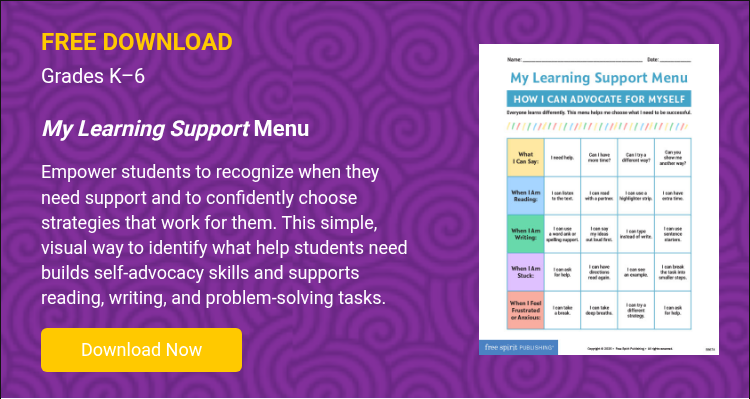
Create a picture-based menu of supports students with dyslexia can choose from, such as
This makes accommodations visible and accessible. Instead of relying on teachers and adults to anticipate needs, students can identify and request support themselves.
This is especially important as students get older. In many classrooms, supports are quietly given by the teacher without naming them. While this can be helpful in the short term, it can limit a student’s ability to recognize and request those same supports later—in middle school, in high school, and beyond.
Teaching what accommodations are called—and why they help—builds long-term independence and strengthens dyslexia self-advocacy.
Address Reading Anxiety and Build Confidence
Struggling readers often feel anxious, especially when students with dyslexia are asked to read aloud or work with unfamiliar text. This anxiety can make it even harder for them to take risks and ask for help.
Self-advocacy plays an important role in reducing that anxiety. When students understand their needs and know how to communicate them, they feel more in control of their learning.
Normalize these feelings and give students tools to manage them. Support strategies include
-
previewing the text
-
offering choice
-
allowing think time
Strategies like this can reduce stress and build confidence.
It’s also important to create a classroom culture where mistakes are expected and supported. Avoid putting students on the spot to read aloud without preparation, and provide multiple ways to engage with the text (listening, partner reading, or shared reading). When students experience successes, however small, their confidence grows. Over time, this confidence makes it easier for students to take risks, to ask for help, and to advocate for their needs.
Book Connections: Name and Tame Your Anxiety helps students understand and manage those feelings. Consider When Everyone Reads to create a joyful, inclusive reading culture where all students feel successful.
Why This Matters for Students with Dyslexia
Students with dyslexia will eventually need to advocate for themselves, especially after high school. Dyslexia is lifelong, and many adults continue to use strategies and support to navigate reading and writing challenges. If we don’t teach students how to ask for help, we leave them unprepared. When we do, we give them something powerful: the ability to understand themselves, to speak up, and to succeed.
Building Confidence Through Dyslexia Self-Advocacy
Self-advocacy is not something that develops overnight; it is built through small, consistent opportunities to reflect, practice, and communicate. When teachers intentionally create space for student voice, they are not just supporting academic growth, they are helping students build life-long skills.
For students with dyslexia, this can be the difference between feeling frustrated and feeling capable. And that shift, from struggling in silence to speaking with confidence, is what truly empowers learners.