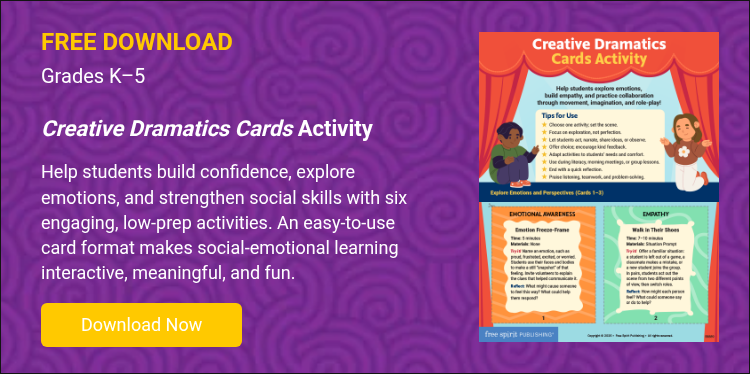
Creative dramatics gives students opportunities to explore emotions, build confidence, and strengthen social skills through improvisation, movement, and role-playing. This article shares this approach to education and explains the benefits of creative dramatics in the classroom. Discover practical creative dramatics activities and tips for helping students develop emotional regulation, self-concept, communication, and collaboration skills.
What Is Creative Dramatics?
Some of you may be aware that I didn’t start my career in education. In fact, my first college degree was in theater. During my undergraduate time, my father used to ask me, “What are you going to do with a theater degree?”
I went into theater because I had a real passion for acting and the art of production. After graduation, I quickly discovered there were few opportunities in the theater world where I could make a living. I wasn’t one to “suffer for my art.” I liked fancy shoes too much! So, I returned to college to get a degree in education. Where else was I going to get a daily captive audience? Little did I know how beneficial that theater training would become.
One area of focus of my theater degree was creative dramatics. Creative dramatics is an improvisational form of acting in which students use movement, pantomime, role-playing, storytelling, and group discussion to explore real and imagined experiences. Unlike a traditional stage production, creative dramatics emphasizes the learning process rather than performing for an audience. Students can experiment with different perspectives, express emotions, solve problems, and reflect on their experiences in a supportive environment.
When teachers incorporate creative dramatics in the classroom, students have opportunities to develop communication skills, social awareness, confidence, problem-solving abilities, and self-concept. The goal is to guide children toward greater self-fulfillment and acceptance (McCaslin, 2005).
Not only can creative dramatics positively impact students’ social and emotional development, increase happiness, and help develop a balanced person, but it can also strengthen content understanding and literacy skills.
Benefits of Creative Dramatics for Social-Emotional Learning
The three main benefits of creative dramatics are strengthening emotional regulation, building confidence and self-concept, and improving social interactions. With simple creative dramatics activities, teachers can help students practice these skills while making meaningful connections to academic learning.
Creative dramatics offers students a chance to practice social-emotional skills through active participation. As students act out situations, collaborate with peers, and explore different points of view, they develop skills they can apply in the classroom and beyond.
Strengthening Emotional Regulation
Creative dramatic activities are designed to benefit the participants, rather than an outside audience as in a stage play. Students learn how to represent externally what they experience internally, allowing them to express themselves in a safe, supportive environment.
When students take on the personality of an individual in a novel, role-play being someone other than themselves, or imagine being a fictional character, they have opportunities to explore emotions and experience acceptance from others. They also learn through collaboration and cooperation how to respond to unfamiliar situations.
These experiences support social-emotional learning (SEL) by helping students recognize feelings, consider different responses, and practice managing their emotions. For example, a teacher might ask students to act out a disagreement between two characters and explore several ways the characters could resolve the situation.
Building Confidence and Self-Concept
An individual’s self-concept, or belief in their own abilities, develops through personal experiences with success and failure, vicarious experiences (seeing others like us succeed), social persuasion (what others say about us), and our own physiological state (our attitudes and feelings about ourselves).
During creative dramatic activities, students quickly learn that there are opportunities to explore, experiment, and try again. Because these activities are unscripted and have few structures, students can take risks and discover new ways to approach a situation. They see others work through challenges, learning from their peers how to solve problems and deal with the unknown.
Feedback from participants after an activity is intended to help students consider what they might try differently next time, rather than serve as a reward or punishment. This approach encourages reflection, persistence, and confidence.
Creative dramatics can also enhance students’ attitudes toward school. The activities are highly interactive, engaging, and flexible, giving students opportunities to contribute ideas and experience success in different ways.
Improving Social Skills and Collaboration
Positive social skills are among the most important attributes of the human experience. Through creative dramatics activities, students practice listening, taking turns, respecting personal space, and responding to others. They also develop an awareness of different perspectives and learn how feedback can help them make positive changes in their behavior.
For students who benefit from structured opportunities to practice social interactions, creative dramatics can provide a flexible setting for developing communication and collaboration skills. Teachers can adapt activities to students’ individual needs, communication styles, and comfort levels.
For example, students working together to act out a story must listen to one another, share ideas, agree on what happens next, and work toward a common goal. These experiences help students practice cooperation and problem-solving in a meaningful context.
Creative dramatics can also help students become more comfortable with uncertainty and mistakes. This is particularly helpful for gifted students who may hesitate to take intellectual risks. When students work through an improvised scene together, they learn to consider different possibilities and collaborate on a resolution. Plus, it’s a lot of fun.
Creative Dramatics Activities for the Classroom
Teachers can incorporate creative drama activities into literacy lessons, classroom meetings, social-emotional learning instruction, and other subject areas. The following ideas offer practical ways to help students build confidence, explore emotions, and strengthen relationships.

1. Role-Playing Activities for Students
Give students a familiar classroom or everyday situation to act out. Examples include sharing materials, joining a group activity, disagreeing with a friend, asking for help, or welcoming a new classmate.
Invite students to work in pairs or small groups to explore how each person might feel and respond. After each role-play, ask questions such as
- What emotions did the characters experience?
- How did the characters communicate their needs?
- What other responses might help resolve the situation?
- How could you apply what you learned to a real-life situation?
These role-playing activities for students help develop empathy, perspective-taking, communication, and problem-solving skills.
2. Emotion Freeze-Frames
Ask students to move around the room as a character, animal, or imaginary person. When the teacher calls “freeze,” students stop and use their facial expressions and body positions to represent a particular emotion, such as excitement, frustration, worry, or pride.
Invite students to describe the clues that communicate the emotion. They might notice a character’s posture, facial expression, or gestures. Students can then discuss situations that might cause someone to feel that way and identify helpful responses.
This activity encourages students to recognize emotional cues and understand how people communicate feelings without words. It can also support vocabulary development as students explore precise words for different emotions.
3. Collaborative Storytelling
Begin a story with a simple opening, such as, “A group of friends discovered a mysterious box on the playground.” Invite students to take turns adding a sentence or acting out the next part of the story.
As the story develops, encourage students to build on one another’s ideas, listen carefully, and work together to decide what happens next. You can introduce a challenge for the characters to solve, such as finding a fair way to share a discovery or working together to complete a difficult task.
Collaborative storytelling strengthens listening, oral language, creativity, and teamwork. It also gives students opportunities to practice negotiating ideas and finding solutions as a group.
4. Act Out Story Characters
During a read-aloud or literature lesson, invite students to act out a scene from a story. Students can use gestures, movement, dialogue, and facial expressions to represent characters and events.
After the scene, discuss the characters’ motivations and feelings. Ask students to consider why a character made a particular decision, how another character might have felt, or what could happen if the characters chose a different response.
These drama activities for students connect literacy instruction with social-emotional learning. Students deepen their understanding of characters, practice perspective-taking, and explore how actions affect others.
Tips for Using Creative Dramatics in the Classroom
Creative dramatics can become a regular part of classroom instruction with a few simple practices. Teachers can start with brief activities and gradually introduce more complex scenarios as students become comfortable participating.
- Establish a supportive environment. Explain that creative dramatics is about exploring ideas and learning together. Encourage students to respect one another’s contributions and treat each activity as an opportunity to experiment.
- Start with simple activities. Begin with emotion freeze-frames, gestures, or short role-plays before moving to longer improvisations. Short activities can fit naturally into morning meetings, transitions, and lesson openings.
- Offer choices for participation. Students can act, narrate, suggest dialogue, observe, or help develop a scene. Flexible participation options allow students to contribute in ways that suit their needs and comfort levels.
- Connect activities to learning goals. Choose scenarios that reinforce the skills or concepts you are teaching. A role-play might explore conflict resolution during an SEL lesson, while acting out a story can strengthen comprehension during literacy instruction.
- Make reflection part of the process. After each activity, invite students to share what they noticed, how they felt, and what they might try next time. Focus feedback on learning, collaboration, and possibilities for growth.
- Adapt activities to your students. Consider students’ ages, communication preferences, sensory needs, and familiarity with improvisation. Clear directions, visual prompts, predictable routines, and alternative ways to participate can help make activities accessible.
Bring Social-Emotional Learning to Life with Creative Dramatics
Creative dramatics gives students opportunities to explore emotions, build confidence, practice social skills, and strengthen academic understanding through movement, imagination, and collaboration. By incorporating these activities into everyday lessons, teachers can create meaningful opportunities for students to learn about themselves and others.
Using creative dramatics can greatly increase a student’s ability to deal with uncertainty and errors, an extremely helpful tool when working with gifted students who are often afraid to take intellectual risks or make mistakes. Working through a creative dramatics situation gets all members of the scene involved in collaboration to find a resolution. Plus, it’s a lot of fun!