Books are more than stories for babies and toddlers. They are tools for discovery, connection, and early learning. Board books, with their characteristic sturdy pages and vibrant visuals, are a wonderful introduction to reading.
This article explores the benefits of board books and ways their unique design supports the youngest children, particularly in engaging high-contrast board books, designed especially for infants. You’ll also find tips for parents and caregivers to choose board books and make opportunities for daily reading.
What Are Board Books?
Board books are typically small books printed on thick, durable cardboard pages designed for babies and toddlers. Their unique and sturdy format allows children to touch, turn, and explore books safely while building early literacy skills such as vocabulary, print awareness, and listening comprehension.
Unlike traditional (and less durable) paper books, board books are created specifically for very young children. The format encourages active interaction and helps children begin to understand how books work.
What Are the Benefits of Board Books for Babies and Toddlers?
Key features that support early readers include:
-
thick pages that withstand rough handling
-
simple text and repetition that support language learning
-
bright or high-contrast illustrations that attract attention and support visual development
-
compact size designed for small hands
These design elements make board books ideal for introducing children to reading long before they can actually read. Early exposure to books and language supports later reading success. According to the American Academy of Pediatrics, shared reading beginning in infancy builds the connection between child and caregiver, supports brain development, and builds social-emotional, cognitive, and language skills. Board books are great for babies and toddlers! And high-contrast board books, in particular, are ideal for babies.
How Do Board Books Support Early Literacy Skills?

Board books support early literacy by helping babies and toddlers build vocabulary, recognize patterns in language, and understand how books work. Through repeated reading experiences, their simple structure helps young children develop foundational skills needed for later reading success.
During the first three years of life, children’s brains develop rapidly. Interactive reading experiences stimulate this development in important ways, highlighting yet another of the benefits of board books: building the foundation for long-term literacy and curiosity.
Vocabulary Growth
Board books introduce children to new words through words and pictures. Pointing to and naming animals and objects, as well as emotions in photos or illustrations helps children connect spoken language with meaning.
Print Awareness
Handling board books helps children understand basic concepts of print, and that:
-
books have a front and back
-
pages turn from left to right
-
pictures and words carry meaning
Listening and Attention
Short sentences and rhythmic language help young children learn to listen to stories and stay engaged.
Oral Language Development
Conversations during reading—asking questions, pointing to pictures, naming objects—encourage children to practice expressive language.
Why Are High-Contrast Board Books Helpful for Babies?
Newborns do not see the world the way adults do. In the first months of life, babies see best when images have strong contrast and simple shapes.
High-contrast board books use bold colors (often black and white) with the goal of helping very young babies see images more clearly. Because infants’ vision is still developing in the first few months of life, these strong contrasts help them to focus on shapes and patterns, supporting visual development and early engagement with books. High-contrast board books may support development in several ways.
Visual Stimulation
High-contrast, bold patterns and shapes help babies distinguish objects and track movement with their eyes.
Focus and Attention
High contrast images seem to engage infants for longer periods of time.
Brain Development
Looking at patterns and shapes stimulates neural connections in areas related to visual processing and early cognition.
High-Contrast Board Books for Babies
The Baby’s First Moments series of six board books features bold black-and-white illustrations specifically designed for babies aged 0–12 months, when developing eyesight benefits from strong contrast.
Each book focuses on a theme connected to early experiences in a baby’s world: nature, family, home, feelings, play, and bedtime. Each book also includes a note for caregivers explaining the value of reading and exploring together with babies.
How to Use Board Books in Daily Routines
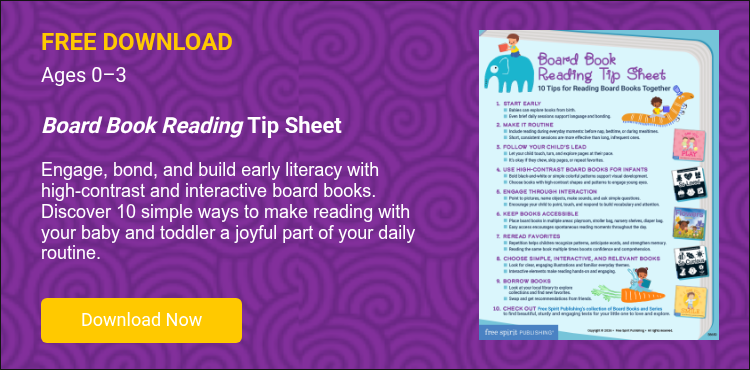
Caregivers can support early literacy and connection building by incorporating board books into everyday routines. Short, consistent reading moments help babies associate books with comfort, connection, and curiosity.
Reading with babies doesn’t require long or structured story sessions. Instead, frequent, short interactions are most effective. There are simple ways to incorporate board books throughout the day.
Bedtime Reading Routine
Reading a board book before bed signals that it is time to wind down. A simple routine might include a bath, pajamas, and a few board books, like Rest: A board book about bedtime by Elizabeth Verdick and Marjorie Lisovskis by and So Sleepy by Emily Barton. This predictable routine helps children associate reading with comfort and relaxation.
Keep Board Books Within Reach
Place board books in baskets around the home so children can explore them independently and caregivers can quickly access and read anytime. Easy access encourages spontaneous reading moments.
Keep board books handy:
-
near the play area
-
in the stroller bag
-
on a nursery shelf
-
in the diaper bag
Follow Your Child’s Lead
Babies and young children may want to:
These behaviors are OK and part of learning. Letting children explore at their own pace supports curiosity and engagement.
Talk About the Pictures
Beyond the text, talking about the board book is another way to engage children. This kind of interactive reading strengthens vocabulary and comprehension.
You might:
-
point to and name objects in the pictures
-
ask simple questions
-
point to and name an animal and make the sound it makes
-
describe colors or actions
How to Choose the Best Board Books for Young Children
The best board books for babies and toddlers feature simple language, engaging illustrations, and themes connected to everyday life. Books that invite interaction are especially effective for building early literacy skills and engaging the littlest learners. When selecting board books, consider the following qualities.
Simple, Repetitive Text
Text should be fun for you to read over and over, as repetition helps children learn language patterns and anticipate familiar words.
Clear, Engaging Illustrations
Look for images that are bright or have high-contrast and are easy to recognize.
Interactive Elements
Many board books include features to encourage exploration and engagement.
Everyday Topics
Young children enjoy books about familiar experiences. These topics help children connect language to their daily lives, on topics such as:
Choose topics relevant to your family and child’s life.
Durable Construction
High-quality board books have rounded corners and thick pages that can withstand enthusiastic handling.
Which Board Book Series Supports Early Literacy Development?
Some board book series are intentionally designed to support early literacy, visual development, and caregiver-child interaction. Series with simple language, engaging illustrations, and developmentally appropriate themes give families reliable options for building consistent reading routines from infancy through toddlerhood.
The following board book series are designed to help young children explore language, emotions, and the world around them while supporting key early learning milestones.
I See You Board Book Series
The I See You board book series for ages 1-3 by Deborah Farmer Kris celebrates toddlers’ physical, emotional, and social milestones. Learn why, according to the author, board books are the most underrated genre.
Outside Our Window Board Books
The Outside Our Window Board Books series by Mélina Mangal encourages children up to age 4—especially those growing up in urban neighborhoods—to notice and explore the natural world around them. Each book focuses on one part of nature while inviting readers to use one of their senses to observe what they see, hear, smell, or feel. The stories also introduce simple ideas about relationships and community, helping families connect with nature and with each other as they explore the world just outside their window.
Curious Me Board Book Series
Young children are natural explorers, and the Curious Me® Board Books series for ages 0-4 celebrates their innate curiosity. Each book in the series invites babies and toddlers to investigate the world around them. The books combine bright illustrations from various artists with simple text to support early vocabulary development while encouraging children to wonder.
Same Board Book, Never Bored
Repeated reading helps young children build memory, vocabulary, and comprehension. Rereading the same board book many times allows children to recognize patterns in language and anticipate what comes next, strengthening early literacy development. High quality board books can be read again, and again, and again!
Reading the same book repeatedly helps children:
-
learn new vocabulary
-
understand story structure
-
develop listening comprehension
-
build confidence with language
Repetition also allows children to participate more actively as they grow: finishing sentences, pointing to pictures, or naming objects they recognize.
Frequently Asked Questions About Board Books
At what age should babies start reading board books?
Babies can begin exploring board books from birth. Newborns benefit from hearing language and looking at simple images, especially high-contrast patterns. Caregivers should read regularly to children, at least until kindergarten, but the benefits of being read to extends far beyond.
How many board books should a child have?
There is no best number of board books. Having several accessible books encourages frequent reading. Rotating books occasionally can keep interest high while still allowing for repeated favorites. Local libraries often have extensive board book collections for families to borrow.
Do board books really help children learn to read?
Yes. Board books support foundational skills such as vocabulary, print awareness, listening comprehension, and language development, all critical building blocks for literacy.
Should babies chew on board books?
Chewing or mouthing on board books is common because babies explore with their mouths. Although board books are designed to be durable, caregivers should always supervise reading time to help ensure books are clean and safe for young children.
The Benefits of Board Books Build a Lifelong Love of Reading
As a child’s first books, board books play a powerful role in their earliest learning experiences. Their durable format invites exploration, while their simple text and engaging visuals support the development of language, attention, and early literacy skills.
Just as importantly, board books create moments of connection between adults and children. Sitting together, turning pages, and talking about pictures builds relationships alongside reading skills.
When parents and caregivers incorporate board books into everyday routines, they help children develop a lifelong association between books, comfort, and curiosity.
Those early moments with sturdy pages and colorful pictures often become the first step toward something much bigger: a lasting love of reading and bonds over books.
Klass, P., Mendelsohn, A. L., Hutton, J. S., Dunlap, M., Anderson, A. T., High, P. C., Navsaria, D., Miller-Fitzwater, A., Roby, E., Navsaria, D., Anyigbo, C. U., Glusman, M., Guevara, J. P., Hashikawa, A. N., Loria, H. M., Miller-Fitzwater, A., Nelson, B. B., Garro, N., Gomez, M., … Recio, L. (2024). Literacy promotion: An essential component of Primary Care Pediatric Practice: Technical Report. Pediatrics, 154(6). https://doi.org/10.1542/peds.2024-069091
Newman, T.-J., McAdams, P., Terry, K., Potter, T., & Franklin, A. (2026). The role of color, contrast, and spatial complexity in infants’ visual engagement with Board and Picture Book Images. Journal of Experimental Child Psychology, 266, 106472. https://doi.org/10.1016/j.jecp.2026.106472