Developing strong oral language skills requires consistent opportunities to listen, speak, and interact with others. For English learners, meaningful classroom conversations can provide valuable practice with new vocabulary, language structures, and ways of expressing ideas. In this article, explore why oral language development matters and discover practical oral language development strategies for creating more opportunities for students to talk, practice, and grow in confidence.
Living in Two Languages
My oldest daughter had just finished brushing her teeth, turned to me, and said, “Mami, I don’t want to speak Spanish anymore.” I was shocked. I stood there thinking, “What? Why? Where did this come from? She’s only three!”
As I reflected on her experience growing up bilingual, I realized that she felt isolated. She had started preschool, and no one spoke Spanish to her there. At family parties, all her cousins spoke English to one another. She and her brother were the only ones who had to repeat themselves in front of everyone because I made them speak Spanish to me.
I didn’t understand what it meant for them to live in two languages. Since my children were born, I committed to only speaking Spanish to them while their father spoke to them in English. If they answered me in English, I would pretend I didn’t understand, forcing them to repeat it in Spanish. It was difficult, and there were many times when I just wanted to give up and speak English to them. They would get frustrated with me, sighing when they had to repeat themselves.
It was difficult for everyone, and I kept asking myself, “Why is this so hard?”
I came to realize that my children did not have enough opportunities to practice using their Spanish.
These experiences with my own children changed the way I thought about oral language development in the classroom. English learners need opportunities to hear language, but they also need frequent, meaningful opportunities to use it. Language grows through interaction, practice, and the confidence to try.
Why Oral Language Development Matters
These daily experiences with my own children remind me of my work as a teacher of English learners. For years, I knew how important it was for students to have lots of opportunities to practice using English in the classroom. I knew I had to hold them accountable for their language skills and be a model for them as English speakers. But what I have come to appreciate is the drive and the patience that my students have with the process of living in two languages.
As teachers, we cannot lose sight of the role of talk in our classrooms. A classroom rich with language opportunities can give children living and learning in two languages more opportunities to participate, communicate, and grow.
Listening is an important part of language learning. Students need to hear language used in meaningful contexts so they can process information, make connections, and build understanding. At the same time, listening needs to be paired with opportunities to speak. When students verbalize their reasoning and explain their thinking, they are putting their language knowledge into practice.
This is at the heart of oral language development. Students need to use language to communicate ideas, respond to others, ask questions, explain their thinking, and participate in conversations. These experiences build oral language skills while giving students meaningful reasons to use new vocabulary and language structures.
Language development also takes place across the school day, not only during designated language instruction. Frequent, authentic opportunities to practice language across content areas allow students to make connections and apply what they are learning.
Create More Opportunities for Student Talk
It has been said repeatedly that classrooms should not be silent. They should be filled with dialogue and discussions between students, where they talk with their elbow partners and their peers on the other side of the classroom.
I know this is not new to teachers. We understand how important it is for English learners to have multiple opportunities to talk about their learning, yet I still visit classrooms where there is silence. Students are listening to language but are not provided the opportunities to use it, to try it out, to make mistakes, and to get better.
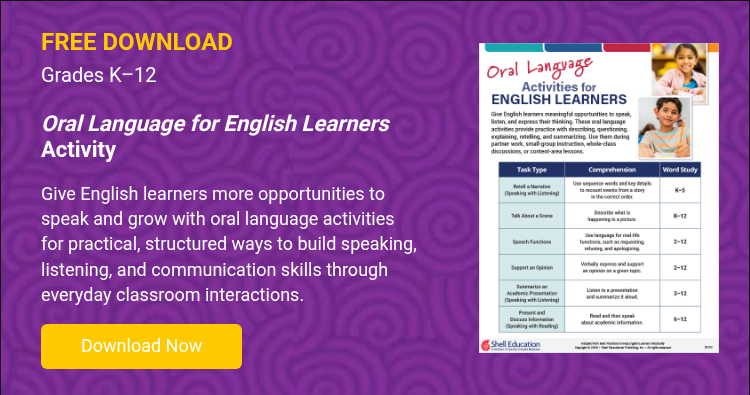
One of the most effective oral language development strategies is simply creating more opportunities for students to talk. Partner conversations, peer discussions, small-group activities, and classroom dialogue can turn language practice into a natural part of instruction.
Consider building short opportunities for student talk into everyday lessons.
- Partner conversations: Give students time to turn and talk about a question, image, text, or new concept.
- Peer discussions: Use open-ended prompts such as “What do you think?” or “Can you explain why?” to encourage students to expand their responses.
- Collaborative learning: Give students meaningful roles that require them to share ideas, ask questions, and respond to their classmates.
- Structured classroom dialogue: Provide sentence frames or discussion prompts that give students a starting point for participating in academic conversations.
- Listen, Think, Pair, Share: Give students time to process what they hear before asking them to discuss their thinking with a partner.
These simple routines can become regular oral language activities for students. They also give teachers opportunities to listen to students and notice which vocabulary, sentence structures, or concepts may need additional modeling and practice.
Sentence frames can be especially useful when students are developing academic language. A frame such as “I think _____ because _____” gives students a structure for expressing and justifying an opinion. Other prompts can support students as they describe a picture, retell a story, summarize information, or explain an idea.
The goal is not for every conversation to sound polished or perfect. The goal is for students to have regular opportunities to participate and use language with purpose.
Let Students Practice and Make Mistakes
When my son says, “Mami, puedo ir outside-a?” I celebrate his trial and errors and remind myself that it is a process.
If I continue to talk with him in Spanish and be a model for him, he will continue to improve his language. But without the opportunities to hear him talk, to allow him to use his language skills, how could he continue his language development?
The same is true in the classroom. Students need to know that trying new language is part of learning. Oral language activities should give students space to experiment with new words, phrases, and sentence structures while receiving encouragement and appropriate feedback.
Teachers can model language naturally by expanding on what students say, introducing more precise vocabulary, or demonstrating how to organize an idea. When a student shares a response, you might affirm what they communicated and then model a way to add detail or clarify the idea.

For example, if a student says, “The plant grow,” a teacher might respond, “Yes, the plant grows because it gets sunlight and water.” The student hears the language used in context and has an opportunity to try it again.
Low-pressure practice matters, too. Students are more likely to take risks when they have supportive opportunities to speak with peers and teachers and receive ongoing feedback. Small-group instruction can provide additional opportunities for repetition, response, modeling, and immediate feedback.
These are important language development strategies because language acquisition takes time. Students may demonstrate different levels of strength across listening, speaking, reading, and writing, and their growth can develop at different rates.
Our role is to keep providing meaningful opportunities to listen, speak, practice, and grow.
Give Students a Classroom Where Their Voices Can Grow
My children’s experiences reminded me that speaking a language requires more than simply hearing it. It requires opportunities to use that language in meaningful interactions, with people who are willing to listen, respond, and encourage another attempt.
The same is true for English learners in our classrooms.
Every partner conversation, small-group discussion, classroom exchange, and opportunity to explain an idea gives students another chance to practice their oral language skills. Over time, these moments can build greater fluency, confidence, and independence.
A language-rich classroom makes room for student voices. It gives English learners the opportunity to use language for authentic purposes, connect with their peers, and see themselves as capable communicators.
When we make space for students to talk, we make space for living in two languages.