Inclusive classroom strategies are essential for effectively teaching neurodiverse students and creating learning environments where every child can thrive. In this article, you’ll explore five reflections on neurodiversity in the classroom, including the difference between accommodating and affirming, how to think more flexibly about teaching neurodiverse students, and what it means to build a neurodiversity-affirming classroom.
Lessons Learned in Building an Inclusive Classroom
I started teaching 20 years ago. If I could send a letter back to the teacher I was in that first year, I’d keep it short: Keep asking questions, keep learning, don’t forget to look at the wins.
I’d tuck that note into a book, Neurodiversity Affirming Schools. Though it was recently published, this is the book I most wish I had when I started, a book whose table of contents made me cry. I hesitate to write about it because I think everyone should read the whole thing, but in honor of it being a full year old now, and because stamps that will send a letter to twenty years ago are too expensive, here are five things about neurodiversity I wish I’d always known as a teacher.
1. Inclusive Classroom Strategies: Accommodating vs. Affirming
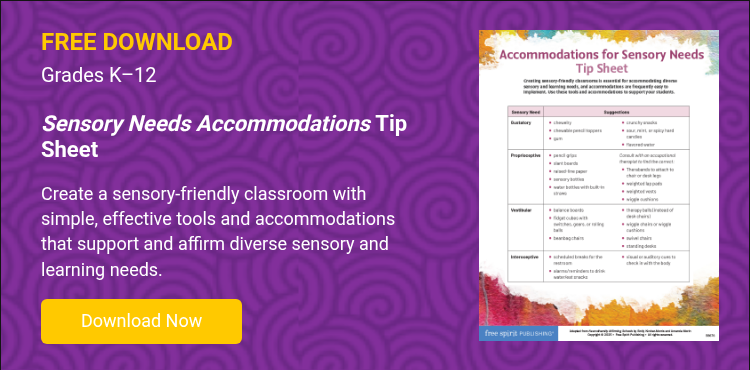
I had a student who was hyper-sensitive to both the sound and light of the big fluorescent lights in the ceilings of every classroom in our school. In that student’s IEP, there was an accommodation that when the student was overwhelmed by the lighting they could go to a spot in the library or the counselor’s office to take a break and work quietly. However, that accommodation meant that the student had to first feel discomfort and then had to leave the room.
My grade level team brought in a bunch of inexpensive lamps and other lighting, so the students walked into rooms that felt comfortable instead of having the option to leave when things were too uncomfortable. As is often true with changes like this, many other students reported feeling more welcome and relaxed in our rooms. There is a huge difference between accommodating and affirming.
I’m not saying go buy lamps and everything will be perfect for every kid, but it’s a small example of changing the environment to meet student needs rather than putting the responsibility on the student to adapt to us.
2. There Are More Good Questions Than Easy Answers
Teaching would be easy if there was a perfect checklist about how to reach every kid. Well, it wouldn’t be easy, but it would be a lot easier than it is. I’m not alone, I’m sure, in hearing about “Universal Design” a hundred times, but it was in Neurodiversity Affirming Schools that I first saw Universal Design tied to neurodiversity in a direct and practical way.
To me, this work is about asking myself constantly as a teacher what my goal for each lesson is and what different kinds of pathways students can take to achieve those goals. By broadening what is allowable in our classrooms, we also make more space for what is possible, and different pathways to learning and showing learning can support students in many ways without sacrificing rigor.
3. “A Linear Spectrum Is Too Shallow”

The first time I opened Neurodiversity Affirming Schools, I scanned the table of contents and was so struck by this chapter name that I honestly teared up.
Thinking of decades of students, of friends and family who are neurodivergent, I’d understood that a spectrum was an insufficient way to express the diversity and brilliance in all those brains but I had never put words to it. This title, and the richness of the content of this chapter, helped re-wire my own understanding of the depth of difference between all brains, not just those considered neurodivergent.
Whatever words on the IEP, whatever the diagnosis, no person exists as a simple checklist of behaviors or abilities. To fully reach, to effectively teach each person in our classrooms, we need to engage and understand all the things that make them the unique person and learner they are.
4. Understanding My Own Neurodivergence
I was diagnosed with ADHD after I turned 40 years old. Although I’d spent so many years in the front of the classroom and in meetings focused on the needs of students with ADHD, learning about how my brain works (both strengths and struggles) helped so much of my own life come into focus. There were reasons some things were especially hard for me, reasons why some days left me so tired, reasons why I felt especially capable in a room full of 8th graders with millions of things happening all at once.
As much as I wish I had Neurodiversity Affirming Schools before my first day of teaching, I wish my teachers had had this kind of information when I was in their classrooms, that I had found more spaces earlier where I could pour my energy into the things I did well instead of trying to act and think like everyone else seemed to.
5. There Is a Body and a Heart and a Stomach Attached to Our Brains
There’s no doubt that the more we learn about our brains, the more intentional, focused, and impactful we can be as educators. I do, however, get a little worried that we’ll focus too much on all those brains in our room and not the whole rest of the person carrying that brain around.
If we can learn anything from advances in education research and from books like Neurodiversity Affirming Schools, it’s that our brains, our students, our classrooms are all too complex and messy for this work to ever feel easy or predictable, which is all the more reason to give room for every different brand of brilliance our students bring every day.
Why Inclusive Classroom Strategies Matter for Teaching Neurodiverse Students
If I could send that letter back twenty years, I’d tell myself to keep asking questions, keep learning, and not to forget to look at the wins. Teaching neurodiverse students with inclusive classroom strategies is about continuing to notice, to adjust, and to grow. The more we shift toward a neurodiversity-affirming classroom, the more we create spaces where students don’t just fit—they belong!